
Country register
🇸🇮 Slovenia — official public-data APIs & datasets
The continuously verified register lists 22 official sources for Slovenia: 7 APIs and 15 datasets published by government institutions, of which 21 are currently verified by live checks. Every entry links its official documentation and carries proof-based officialness scoring.
Ecologically important areas
The data set shows the spatial distribution of areas classified as ecologically important in Slovenia, which were adopted by the Decree on ecologically important areas (UL RS Nos 48/04, 33/13, 99/13 and 47/18). An ecologically important area under the Nature Conservation Act is an area of a habitat type, part of a habitat type or a larger ecosystem unit that contributes significantly to the conservation of biodiversity.
Groundwater quality monitoring sites
The register includes a list of monitoring points for groundwater quality in the national monitoring network carried out by the Environmental Agency of the Republic of Slovenia. Each record in the record contains the code of the measuring point, the name of the measuring point, the type, the code of the water body, the name of the water body, the municipality, the river basin, the sub-basin, the hydrographic areas and the coordinates (D96/TM: E and N, D48/GK: X and Y).
National network of seismic observatories
State network observatories are used to record earthquakes. Data from observatories are collected and processed at the data processing centre at the Environmental Agency of the Republic of Slovenia, the Office for Seismology in Ljubljana. The national network of seismic observatories includes 26 observatories. The file contains information on the location of seismic observatories.
Register of Natural Values (Areas)
The list of natural values defines the natural values in the area and is intended for their protection. Data on the spatial distribution of natural values in Slovenia and the associated attribute data are intended for the preparation of nature conservation guidelines for plans, programmes, plans, spatial or other acts, as well as their amendments or additions and the preparation of management plans of protected areas. In addition, they enable various analyses, comparative evaluation and are helpful in operational nature conservation work. Last but not least, they are intended for landowners and for raising awareness among the general public about the richness of Slovenia's natural heritage or natural values and the importance of protecting them. The data set shows the spatial distribution of areas of natural values in Slovenia as defined by the Rules on the determination and protection of natural values (UL RS Nos 111/04, 70/06, 58/09, 93/10, 23/15, 7/19 and 53/23), issued on the basis of Article 37(6) of the Nature Conservation Act (UL RS Nos 96/04 – official consolidated text, 61/06 – ZDru-1, 8/10 – ZSKZ-B, 46/14, 21/18 – ZNOrg, 31/18, 82/20, 3/22 – ZDeb, 105/22 – ZZNŠPP and 18/23 – ZDU-1O). According to the Nature Conservation Act, in addition to a rare, valuable or famous natural phenomenon, a natural value is also another valuable phenomenon, an ingredient or part of a living or non-living nature, a natural area or part of a natural area, an ecosystem, a landscape or a shaped nature. Objects and areas of natural values include in particular: geological phenomena, minerals and fossils and their deposits, surface and underground karst phenomena, underground caves, gorges and secluded and other geomorphological phenomena, glaciers and forms of glacial activity, springs, waterfalls, rapids, lakes, bogs, streams and rivers with banks, seashores, plant and animal species, their exceptional specimens and their habitats, ecosystems, landscapes and shaped nature. The.

Splošni pogoji uporabe – ADP
Anketa o porabi časa (APČ) je statistično raziskovanje, s katerim želimo poizvedeti, kako ljudje porabljamo čas oz. koliko časa porabimo za kaj. Anketiranje poteka s pomočjo anketnih dnevnikov o porabi časa. Rezultati ankete bodo uporabni pri oblikovanju politike zaposlovanja, iz njih bo mogoče ugotoviti tudi delitev dela med spoloma, uporabni bodo pri oblikovanju politike za starejše in mladino, pri analizah preživljanja prostega časa, aktivni in pasivni udeležbi na kulturnih in športnih prireditvah, času, ki ga ljudje namenijo množičnim medijem, transportu, namenu in načinu potovanja, ovrednotenju neplačanega dela.
Polnilnice za e-vozila na območju Mestne občine Maribor
Polnilna postaja za polnjenje e-vozila, postavljena na javnosti dostopnih površinah, na katerih lahko polnijo električna vozila vsi uporabniki e-vozil. Polnilnice za e-vozila vsebuje podatek o lokacijah polnilnih postaj, ki so v lasti različnih deležnikov: Mestne občine Maribor, Elektro Maribor, Dravske Elektrarne, Elektro Maribor Energija Plus in Petrol.
Anketa o delovni sili, 2003
Anketa o delovni sili 2003 je raziskovanje, ki ima v Sloveniji dolgoletno tradicijo. Raziskava meri stanje na trgu delovne sile, poleg tega pa še druge lastnosti prebivalstva v določenem tednu vsakega četrtletja. Anketa daje podatke o velikosti, strukturi in značilnostih aktivnega in neaktivnega prebivalstva Republike Slovenije. V vsakem četrtletju sodeluje okoli 20.000 anketirancev. Raziskovalcem je na voljo neanonimizirana verzija ADS mikropodatkov, do katere lahko dostopajo v varni sobi ali preko oddaljenega dostopa. Raziskovanje poteka v sklopu Eurostatove Labour Force Survey. Raziskovalcem so preko Eurostata dostopne tudi podatkovne datoteke drugih sodelujočih držav, ki omogočajo medčasovno in mednarodno primerjavo.
Anketa o delovni sili, 2011
Anketa o delovni sili 2011 je raziskovanje, ki ima v Sloveniji dolgoletno tradicijo. Raziskava meri stanje na trgu delovne sile, poleg tega pa še druge lastnosti prebivalstva v določenem tednu vsakega četrtletja. Anketa daje podatke o velikosti, strukturi in značilnostih aktivnega in neaktivnega prebivalstva Republike Slovenije. V podatkovno datoteko so dodani še podatki o dohodku fizičnih oseb (register DURS-a) – gre za mesečni dohodek, ki je ali povprečje leta ali povprečje krajšega obdobja, če je oseba delala manj kot leto dni. V vsakem četrtletju je v vzorec izbranih približno 19.750 posameznikov. Raziskovalcem je na voljo neanonimizirana verzija ADS mikropodatkov, do katere lahko dostopajo v varni sobi ali preko oddaljenega dostopa. Raziskovanje poteka v sklopu Eurostatove Labour Force Survey, v katero je bilo v letu 2011 zajetih 27 držav Evropske unije, 4 države kandidatke ter 2 EFTA državi – Norveška in Švica. Raziskovalcem so preko Eurostata dostopne tudi podatkovne datoteke drugih sodelujočih držav, ki omogočajo medčasovno in mednarodno primerjavo.
Indicators of population, gender equality and poverty, Slovenia, 1995 - 2015
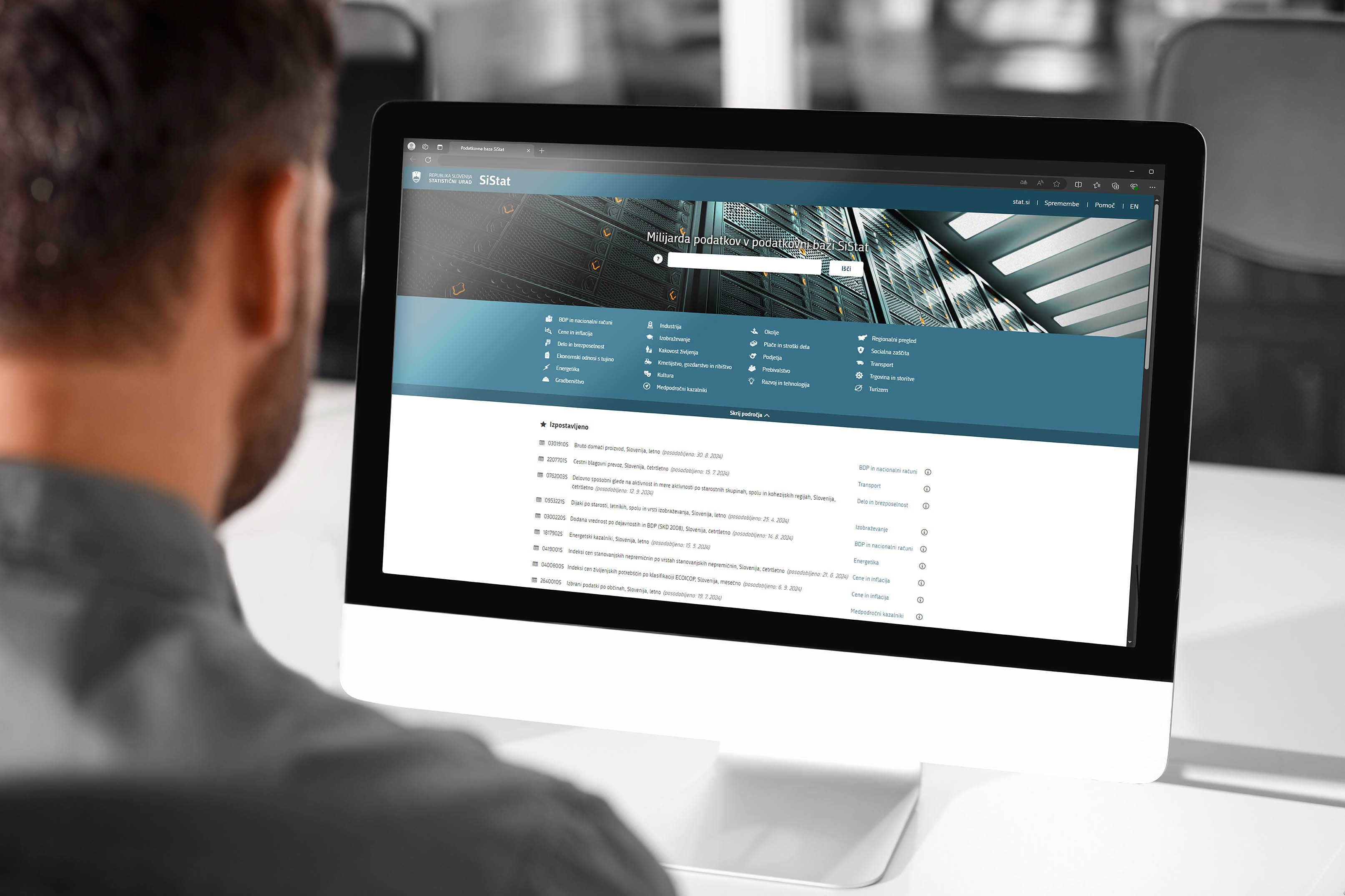
This collection automatically captures metadata sourced from the GOVERNMENT OF THE REPUBLIC OF SLOVENIA STATISTICAL OFFICE OF THE REPUBLIC OF SLOVENIA and corresponds to the source collection entitled "Population indicators, gender equality and poverty, Slovenia, 1995 - 2015". The actual data is available in PC-Axis (.px) format. Among the additional links, you can access the page of the source portal for insight and selection of data, and there is also the PX-Win program, which can be downloaded for free. Both allow you to select data for display, change the printout format and store it in different formats, as well as view and print tables of unlimited size and some basic statistical analyses and graphical representations.
Labour Force Survey, 2005
The Labour Force Survey 2005 is a survey that has a long tradition in Slovenia. The survey measures the state of the labour market. in addition, other characteristics of the population in a particular week of each quarter. The survey provides data on the size, structure and characteristics of the active and inactive Population of the Republic of Slovenia. Almost 23,800 households participated in all four quarters. Researchers have access to a non-anonymised version of ADS microdata. a safe room or via remote access. The survey is carried out by Eurostat's Labour Force Survey - in 25 EU Member States, four candidate countries and three EFTA countries. Data files from other participating countries are also accessible to researchers via Eurostat, allowing for inter-temporal and international comparisons.
Labour Force Survey, 2006
The 2006 Labour Force Survey is a survey that has a long tradition in Slovenia. The survey measures the state of the labour market. in addition, other characteristics of the population in a particular week of each quarter. The survey provides data on the size, structure and characteristics of the active and inactive Population of the Republic of Slovenia. In addition, data on the income of natural persons (DURS register) are added to the data file – this is a monthly income that is either average or the year or the average of the shorter period if the person has worked for less than one year. Over 23,600 households participated throughout the year. Researchers have access to a non-anonymised version of ADS microdata, which can be accessed in a safe room or via remote access. The research is carried out as part of the Eurostat's Labour Force Survey - in 25 EU Member States, four candidate countries and three EFTA countries. Researchers data files from other participating countries are also available via Eurostat to enable inter-temporal and international comparisons.
Labour Force Survey, 2008
The Labour Force Survey 2008 is a survey that has a long tradition in Slovenia. The survey measures the state of the labour market. in addition, other characteristics of the population in a particular week of each quarter. The survey provides data on the size, structure and characteristics of the active and inactive Around 22,800 households participated throughout the year. Researchers have access to a non-anonymised version of ADS microdata. They can be accessed in a safe room or via remote access. The research is carried out as part of the Eurostat Labour Force Survey covering 27 European Union countries, 3 candidate countries and 3 EFTA countries – Norway, Switzerland and Iceland in 2008. Researchers data files from other participating countries are also available via Eurostat to enable inter-temporal and international comparisons.
Labour Force Survey, 2010
The Labour Force Survey is a survey that has a long tradition in Slovenia. The survey measures the state of the labour market, as well as other characteristics of the population in a particular week of each quarter. The survey provides data on the size, structure and characteristics of the active and inactive population of the Republic of Slovenia. The survey is part of the Eurostat Labour Force Survey, which covered 27 European Union countries, 4 candidate countries and 2 EFTA countries – Norway and Switzerland in 2010. 22,714 households participated in Slovenia throughout 2010. Data files from other participating countries are also accessible to researchers via Eurostat, allowing for inter-temporal and international comparisons. The Social Science Data Archive under the code ADS10P distributes an anonymized version of the original deindividualized data file, which is distributed under the code ADS10 by the Statistical Office of the Republic of Slovenia in its secure room and via remote access. The data files also include data on the income of natural persons (the DURS register) – this is a monthly income that is either the average of the year or the average of a shorter period if the person has worked for less than a year. The income in the anonymised data file is classified in 10 approximately equal classes, and variables with exact amounts are only available in the original ADS10 file.
Microdatabase of social statistics for the development of the microsimulation model, 2007
Microdatabase of social statistics for the development of microsimulation The 2007 model was prepared at the Statistical Office of the Republic of Slovenia for the needs of the development of the microsimulation model to model the effects of changes in tax, social transfer and health legislation. The random sample includes 40,000 households or 112,839 people. Compiled or merged from several databases for the year 2007 and some added variables from the 2002 Census. The administrative data used were derived from various administrative resources of institutions of the Republic of Slovenia, such as the Ministry of the Interior, the Surveying and Mapping Authority, Ministry of Labour, Family, Social Affairs, Tax Administration, Pension and Disability Insurance Institute, Institute Employment, Institute of Health Protection and Health Insurance Institute. In addition to these, they are also used. statistical registers and data from statistical surveys carried out by the Statistical Office.
Microdatabase of social statistics for the development of the microsimulation model, 2010
Microdatabase of social statistics for the development of microsimulation The 2010 model was prepared at the Statistical Office of the Republic of Slovenia for the needs of the development of the microsimulation model to model the effects of changes in tax, social transfer and health legislation. The random sample includes 120,046 people. It is composed or merged from several databases, most of them for 2010 (e.g. registered unemployed, personal income tax, benefits, students, etc.), and some also for 2011 (e.g. real estate, registration register) and 2012 (scholarships). The administrative data used were derived from various administrative sources of the institutions of the Republic of Slovenia, such as the Ministry of the Interior, the Surveying and Mapping Authority, the Ministry of Labour, Family, Social Affairs, the Tax Authority, Pension and Disability Insurance Institute, Employment Service, Health Protection Institute and Health Care Institute insurance. In addition, statistical registers and data from statistical surveys conducted by the Statistical Office are used.
Persons in paid employment by amount of net earnings, by public and private sector and by sex, Slovenia, 2009 - 2020
This database automatically captures metadata sourced from the GOVERNMENT OF THE REPUBLIC OF SLOVENIA STATISTICAL OFFICE OF THE REPUBLIC OF SLOVENIA and corresponds to the source database entitled "Employed persons by amount of net earnings, by public and private sector and by sex, Slovenia, 2009 - 2020". The actual data is available in PC-Axis (.px) format. Among the additional links, you can access the page of the source portal for insight and selection of data, and there is also the PX-Win program, which can be downloaded for free. Both allow you to select data for display, change the printout format and store it in different formats, as well as view and print tables of unlimited size and some basic statistical analyses and graphical representations.
Judicial statistics (Bilten)
The Ministry carries out statistical surveys in order to monitor the situation in the field of justice, by all interested users (legislative body, ministries, judicial authorities and other professional public) provides an overview of the state and operation of the courts, and in this way provide a data basis for decision-making in the event of a legislative change; the operation of the courts and other appropriate measures to ensure their efficient operation; courts. Pursuant to Article 74 of the Courts Act.
Strateške karte hrupa za pomembne železniške proge
Strateške karte hrupa za pomembne železnice, v upravljanju Slovenskih železnic d.o.o., so izdelane skladno z Direktivo Evropskega parlamenta in Sveta 2002/49/ES z dne 25. junija 2002 o ocenjevanju in upravljanju okoljskega hrupa in Uredbo o ocenjevanju in urejanju hrupa v okolju (Uradni list RS, št. 121/04). Zbirka podatkov je prostorski prikaz obremenitve okolja s hrupom, zaradi prometa po pomembnih železniških progah, na oddaljenosti do 1500 m od osi cest. Ocena obremenjenosti okolja s hrupom zaradi železniškega prometa je izdelana z modelnim izračunom na podlagi predpisane računske metode in na podlagi meritev celotne obremenjenosti okolja s hrupom na značilnih lokacijah ob obravnavanih virih hrupa. Za izračun obremenjenosti okolja s hrupom je treba poznati značilnosti obratovanja virov hrupa oziroma obseg in razporeditev njihovih emisij hrupa ter meteorološke, reliefne in poselitvene značilnosti obravnavanega območja, med njimi tudi podatke o obstoječih ovirah za preprečevanje širjenja hrupa v okolju, kot so protihrupne ograje in nasipi. Različne barve na kartah hrupa predstavljajo različne dolgoročne povprečne ravni hrupa za kazalca Ldvn (celodnevno obdobje: dan-večer-noč) in Lnoč (obdobje noči), v pasovih po 5 dB(A). Skladno z določili zakonodaje so bili v III. fazi izdelave strateških kart hrupa obravnavani odseki pomembnih železniških prog z več kot 30 000 prevozov vozil letno, določeni na podlagi prometnih podatkov iz leta 2017. Strateške karte hrupa za pomembne železnice v upravljanju Slovenskih železnic d.o.o., so izdelane z namenom ocenjevanja izpostavljenosti prebivalcev hrupu v okolju, zaradi prometa po pomembnih železniških progah in so izhodišče za pripravo ukrepov za zmanjševanje hrupa prometa po železnicah, ki se jih podrobneje opredeli v operativnem programu varstva pred hrupom.